Ladies and Gentlemen! I am absolutely DELIGHTED to present to you... the proverbial Creme de la Creme of the icthyological realm. The KING of fish! The descendant of the great beast MEGALODON. I give you.... The Great White Shark!!!

If you know me well, you may be wondering why I haven't done this AOTW already... I mean, it IS my favorite animal ever! My answer is simply- I haven't the slightest idea.
The great white shark. In my opinion, easily one of the most beautiful animals on the face of the earth. This beast of legends and lore is not what many people think, though. A monster, it is not. A maneater, it is not. Interesting, it sure as dern heck is!
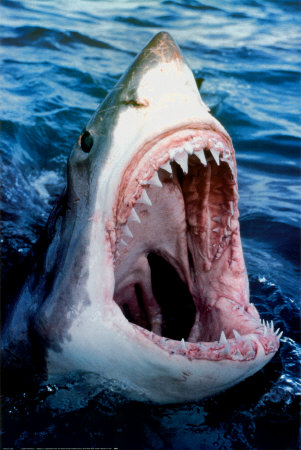 C. carcharias (yes, I've memorized the spelling of that) belongs to the Carcharodon genus, in which it is the only species. Great whites are the largest of the lamniformes (or, commonly, mackerel sharks), which are pretty much the text-book shark that most people think of when they hear the word shark. But the main issue is that the picture they see in their mind is usually similar to this one. Over thousands of years, humans have attributed the great white's fearsome appearance to a habit of eating human flesh, which is extremely inaccurate. In fact, sharks spit humans out when they get a taste because we don't taste very good! The main reason a great white ever has to attack a person is when he or she is floating at the surface in a wetsuit. Why is that? The answer is pretty simple! Sharks eat seals, and from 40 yards away, and the sun shining from above, you look pretty darn identical to a seal. And once that happens, a hungry shark goes into beast mode. The shark will roll its eyes back into their heads in order to protect them and just torpedo up at whatever it is that it may be going for. My point is that sharks don't just go around attacking people for the fun of it.
 Now that I've gotten that out of the way, I'll get to the facts and all that good stuff. The great white shark is the largest predatory fish in the ocean right now, and is one of the primary predators of marine mammals. As I said before, they eat mostly seals and sea lions. It so turns out that I live very close to one of the 3 largest concentrations of pinnipeds (seals, sea lions, walruses, etc.) on earth. This, in turn, means that I also live near one of the 3 areas most inhabited by C. carcharias. These three areas are off the coasts of Southern California, South Africa, and Australia.
Since we're talking about WHAT great whites eat, what about HOW sharks eat? Sharks are very unique in many ways, especially in their feeding behavior. Many great whites, especially those living in the regions previously mentioned, actually JUMP clear out of the water in the attempt at catching seals. This is simply because seals are fast, and slippery, and the further out of the water the shark gets, the better grip it can get on the seal. This video shows the surreal occurrence in slow motion. It really makes you realize how powerful and breathtaking C. carcharias really is. I think it's one of the most beautiful natural phenomena on earth.
Great whites eat seals, because apparently seals taste good. why do YOU think that you almost never hear of a shark actually consuming a person? It's simply because humans don't taste very good. Not enough meat or fat, whereas a seal has a thick layer of blubber, and lots of muscle underneath.
That brings me to my next topic, which is what kind of impact have sharks had on people, and vice-versa? For thousands of years, probably ever since humans stepped foot on earth and came in contact with sharks, great whites have been on the sharp end of the stick, and mostly because they don't look very nice. And then, to magnify the issue, sometimes a shark attacks a person. Ever since the first shark attack, humans have automatically associated the word "shark" with evil. What has this led to on the sharks' side? Millions of sharks just killed for the sake of killing, because a lot of people think that sharks need to die, that they are the devil's beasts, blah blah blah. And if you've read my other posts, you know that even the slightest unnecessary change in a marine ecosystem can throw everything off. Imagine what happens when millions of one of the most important animals in the food chain are killed?

I went on a little rant for a while there, so I'm just gonna get back to the facts. Sharks are really unique animals and have a lot of really cool characteristics that no other animals have. For starters, sharks have a very interesting set of teeth. in fact, sharks don't really have teeth in their mouths, per se. A shark's teeth are actually hardened, dense scales. The main difference between a shark's teeth and most animals' is that shark teeth don't have roots, which means they are relatively easy to be broken or pulled out. To compensate for this, sharks have another unique dental characteristic. A shark's teeth grow in endless rows, as if on a conveyor belt. The image above is a model of a cross section of a great white's jaw. You can see here how the teeth flip up out of the jaw and around it, and this is a process that doesnt end until the shark dies. Their bodies are constantly making new teeth.
As I've already spent a lot of words ranting, and this post is getting quite long, I'm going to end it here, and continue in another AOTW! :) Thank you for reading! And if you want to learn more about C. carcharias, Google is a good start :) Have a great day!!
Great whites eat seals, because apparently seals taste good. why do YOU think that you almost never hear of a shark actually consuming a person? It's simply because humans don't taste very good. Not enough meat or fat, whereas a seal has a thick layer of blubber, and lots of muscle underneath.
That brings me to my next topic, which is what kind of impact have sharks had on people, and vice-versa? For thousands of years, probably ever since humans stepped foot on earth and came in contact with sharks, great whites have been on the sharp end of the stick, and mostly because they don't look very nice. And then, to magnify the issue, sometimes a shark attacks a person. Ever since the first shark attack, humans have automatically associated the word "shark" with evil. What has this led to on the sharks' side? Millions of sharks just killed for the sake of killing, because a lot of people think that sharks need to die, that they are the devil's beasts, blah blah blah. And if you've read my other posts, you know that even the slightest unnecessary change in a marine ecosystem can throw everything off. Imagine what happens when millions of one of the most important animals in the food chain are killed?

I went on a little rant for a while there, so I'm just gonna get back to the facts. Sharks are really unique animals and have a lot of really cool characteristics that no other animals have. For starters, sharks have a very interesting set of teeth. in fact, sharks don't really have teeth in their mouths, per se. A shark's teeth are actually hardened, dense scales. The main difference between a shark's teeth and most animals' is that shark teeth don't have roots, which means they are relatively easy to be broken or pulled out. To compensate for this, sharks have another unique dental characteristic. A shark's teeth grow in endless rows, as if on a conveyor belt. The image above is a model of a cross section of a great white's jaw. You can see here how the teeth flip up out of the jaw and around it, and this is a process that doesnt end until the shark dies. Their bodies are constantly making new teeth.
As I've already spent a lot of words ranting, and this post is getting quite long, I'm going to end it here, and continue in another AOTW! :) Thank you for reading! And if you want to learn more about C. carcharias, Google is a good start :) Have a great day!!


