Showing posts with label earth hugs. Show all posts

Friday, June 3, 2011

Extinction of the Masses... Again?

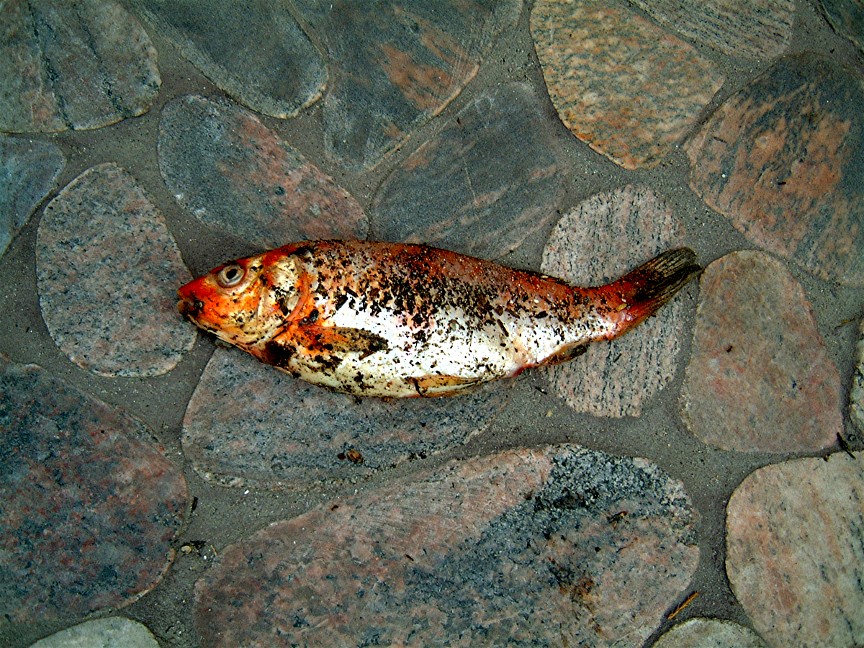
Uh oh... Scientist have recently discovered an alarming piece of evidence that suggest that prehistoric mass extinctions in the past may be a warning that the same thing could easily happen again. And it is all due to greenhouse gases. Greenhouse gases are gases that cause infrared radiation in the lower atmosphere, which in turn causes a strong increase in temperature on earth (a WHOPPING 60 degrees Fahrenheit!). Global warming is caused by these dangerous temperature spikes. There are now so-called "greenhouse oceans" which have lower oxygen levels and higher carbon dioxide levels than they ever had before, and it's all because of greenhouse gases. 

What does that have to do with mass extinction? As a matter of fact, a new development in core sample studies have shown that greenhouse oceans had (theoretically) a great impact on many prehistoric environments. Geologists off the coast of western africa studied layers of sediment from the late Cretaceous Period across a 400,000 year timespan. What they discovered is very alarming, considering the predicament we find ourselves in at the moment. They found a very large amount of marine life remains in the sediment. they were all buried within a layer of dangerously deoxygenated layers of the sediment. 

The even scarier thing is that there are already many "dead zones" in the oceans, which are areas of water which have been deprived of oxygen and loaded with CO2, rising temperatures, and runoff from agriculture. This is a sign that the oxygen levels on earth are depleting. But it's not over! As you may know, the ocean is a very sensitive environment. Even the tiniest variation in temperature or vital gas levels can throw an entire ecosystem off-kilter. So when the oxygen decreases, millions of marine organisms die, and millions more are forced to new ecosystems. 

On the brighter side, though, these periods of oxygen depravity (called hypoxic phases) seem to be temporary, and the oxygen levels improve. But this doesn't mean that these phases cannot be prevented, or at least made to happen less often. The only way to do that would be to treat the earth differently, and try to stop the advance of global warming.

original article:
http://www.sciencedaily.com/releases/2011/05/110517105812.htm

Thursday, May 19, 2011

Adopt-A-Shark...???

Sharks are, without any doubts or second thoughts, my favorite of all animals. No, not the man-eating sharks you see in false media depictions, like in "Jaws" or "Deep Blue Sea". I'm talking about the group of animals, belonging to the superorder Selachimorpha, who are, in my opinion, one of the most beautiful groups of animals on earth. Sharks are a very important part of any marine ecosystem, in ways that most people would think of as negative impact. Sharks are up at the top of the food chain in most of the oceans, which means that they have very few or, in most cases, no natural predators. As a result, they are the ones who eat the most, but they are naturally not as abundant as the animals who are a bit lower on the food chain. The only problem with humans is that for thousands of years, the common person has looked at sharks as "sea devils", and other names which suggest that sharks are evil. Sharks are NOT evil! They don't even like the taste of humans! My point is that sharks are not the ones to look out for, it's the people killing them out of fear of the unknown. We should be protecting sharks, if anything! This leads me to tell you about a program I recently stumbled upon while browsing MarineBio.org 

You may have heard of "Adopt-a-road" programs in your city, or seen those commercials that plead for you to donate a small amount of money every month to feed children in some remote place on earth, but I bet you haven't heard about the new program recently started in Miami, Florida, in order to help the conservation of the native shark species in that area. This article  is all about the program. Don't get all excited, there! No, you cannot actually adopt a shark to have as your pet. But what you can do is donate a sum of $2000.00 for a satellite tracking device to be attached to a shark off the Florida coast. So why should you donate your hard-earned money to this research program? Because first of all, sharks are one of the most important parts of the SW U.S. ecosystem. In fact, they are the most important in most ecosystems on earth. You may not know this, but the animals at the top of the food chain are just as important as plants, if not more so. Nevertheless, they are still the group of species in an ecosystem with the smallest population. This leads to the second reason to donate, which is that the research that will no doubt come out of this program could lead to new conservation measures, such as keeping zones of the coastal waters that have a high concentration of sharks off-limits to fishers. This would help to keep the native sharks abundant in the coastal waters, so they can continue to play their role in nature. Check out this article and decide for yourself how much you care about these amazing animals!


Read more: http://www.bellinghamherald.com/2011/05/18/2019489/floridas-adopt-a-shark-program.html#ixzz1MpCPyRtV

Thanks for reading!

Tuesday, April 26, 2011

Plastic Pacific

That gray blob above the scale outline
of Texas is the approximate location
and size of the Great Pacific Garbage Patch.
WHAT'S UP, PEOPLE? Hey, guys... I want to talk about a very serious issue that has been around since the invention of a thing called plastic. As many of you may know, the ocean is one of the most polluted environments on earth. We humans dump over 14 billion pounds of garbage into the oceans every year. There is actually a legitimate patch of floating garbage in the Pacific Ocean which is twice as large as the state of Texas. Most of this waste is plastic! Plastic is made from petroleum, a substance that the ocean cannot digest, or decompose. So over thousands of years, the bits of plastic just get smaller, and break up, but never completely decompose. So, there ends up being trillions of little specs of plastic. You might be wondering, "What's so bad about little microscopic pieces of plastic?" Even though those little tiny specs may not harm larger fish and other animals directly, the particles set off a chain of events. Not a good one, either.
More Plastic Than PLANKTON???

This is what pretty much happens: Microscopic flecks of plastic are eaten by plankton. Plankton die, or get sick. Now there is 6x as much plastic as plankton, and most of the plankton are now contaminated. These contaminated plankton are then consumed, along with the larger pieces of plastic, by small fish. This fish is now contaminated. Repeat this scenario all the way to the top of the food chain, and shazam! You have an entire ecosystem of either dead or contaminated organisms! 


Jellyfish tangled in plastic debris.

It is really sad, if you ask me. But that isn't even the worst part. There is already so much plastic floating in the ocean that marine ecologists and marine engineers are no longer trying to figure out how to remove it all. In harsher words, we pretty much screwed ourselves beyond the point of return.


According to scientists, our only hope as of today is to stop contributing to the trash dump which used to be our beautiful oceans.


That being said, I want to point you towards Recycling 101. This site will tell you all you need to know about the habit that just might save the world: RECYCLING! Now that you've read this, pick up a bottle when you see it lingering around a gutter or in a pond. You never know what kind of animals' lives you just might save. 
Related Posts Plugin for WordPress, Blogger...